The Happy Hosta
Tokudama Flavocircinalis Hosta
Regular price
$19.00 USD
Regular price
Sale price
$19.00 USD
Unit price
per
Shipping calculated at checkout.
Couldn't load pickup availability
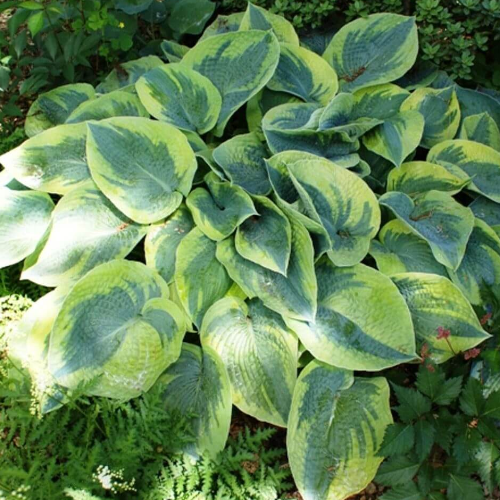
The 'Tokudama Flavocircinalis' Hosta is a highly popular perennial prized for its striking, thick, and heavily corrugated blue-green leaves with wide, irregular golden margins. It is an excellent, low-maintenance choice for shady garden areas due to its slug resistance and attractive foliage. Characteristics and Growing Information
- Foliage: The key feature is its large, nearly round leaves that are frosty blue-green in the center with wide, chartreuse to gold edges. The leaves have a distinctly puckered, corrugated texture.
- Flowers: Fragrant, bell-shaped, pale lavender or near-white flowers appear on tall stalks (up to 28 inches) in mid-summer (July).
- Size: It typically grows to a height of 16 to 20 inches with a spread of 24 to 36 inches at maturity.
- Growth Rate: It has a moderate growth rate and generally takes about a year to establish itself fully.
- Hardiness Zones: It is hardy in USDA zones 3 through 9.
- Pest Resistance: Reviewers and experts note its excellent slug resistance, which is a major advantage for hostas.
Care Instruction
- Light Requirements: The plant does best in partial to full shade. More sun exposure tends to make the blue color greener, so shade is recommended for the best color display.
- Soil Requirements: It prefers fertile, moist, and well-drained soil, but tolerates a wide range of soil types, including acidic or clay soil.
- Watering: It has average water needs and should be watered regularly, but not overwatered. Consistent moisture is important, especially during the first growing season.
- Maintenance: Fertilize once per year, about six inches away from the base, with a slow-release product. Remove spent flower stems to keep the plant tidy for the remainder of the season. Mulch +/- 2 inches for the first winter to protect the roots from frost heaving, removing it in early spring.